
Lower Merion City Directory Collections
Lower Merion has useful city-directory material, but not one uninterrupted township publication. The documented shelf includes a Neighborhood Club volume, a Main Line business and residential directory, Woman's Club runs, and a community publication. They are selective sources made for particular communities or organizations. Treat each as evidence that a name or address appeared in that publication, not as an exhaustive annual list of Township residents. The Lower Merion Historical Society collections and its bibliography are the clearest local starting point.
| Collection | Years | Where Held | Access |
|---|---|---|---|
| Cynwyd-Bala Directory, Neighborhood Club | 1909 | LMHS bibliography and local-history holdings | Ask staff to inspect the edition and its entry fields. |
| Main Line Residential and Business Directory | 1911-1912 | LMHS local bibliography; Ardmore, Hawkins Ad Agency | Regional address and business cross-check. |
| Bala-Cynwyd directory | 1912-1913 | FamilySearch Library catalog reference | Availability and page fields were not inspected in the source research. |
| Woman's Club of Bala-Cynwyd directories | 1966-1968; 1978-1980 | LMHS local bibliography | Organization-limited runs, not a complete public roll. |
| Your Bala-Cynwyd | circa 1937 | LMHS collections and local-history material | Community context and institutional leads. |
The known dates are separated by long gaps, and the research did not establish complete holdings for every library branch. A FamilySearch catalog reference identifies a 1912-1913 Bala-Cynwyd directory, yet the catalog and images were not inspected. Local material also points to Philadelphia and Main Line directories, yearbooks, maps, clippings, and burial records. Those companions often answer the date or address question that a single local publication cannot.
Lower Merion City Directories Are Patchwork
That patchwork reflects the Township's Main Line geography. Bala, Cynwyd, Ardmore, and other community labels can appear in records without being interchangeable municipal names. Narberth is a separate borough. Early material may also use Athensville for Ardmore, or Merionville and Academyville for Bala-Cynwyd. Record the label printed in the source before searching another catalog, map, or deed index.
Community publications, school material, regional books, and local archive files each cover a different slice of life. A directory result may help frame a family-history question, while an atlas, parish, school, or county record supplies corroboration. That is a stronger method than treating any one publication as a modern resident roll.
Lower Merion City Directory Years
The 1909 Cynwyd-Bala Directory is tied to The Neighborhood Club. Local historical material notes 136 active members and two associate members on January 1, 1909, and reports 503 households and businesses in Bala and Cynwyd in 1906. Those figures explain the community setting, not the directory's total coverage. The 1911-1912 Main Line volume adds a regional check, especially where an address or business crossed the Philadelphia line.
The Woman's Club of Bala-Cynwyd runs for 1966-1968 and 1978-1980 likewise need a membership-context reading. In April 2026, LMHS announced that its Woman's Club collection had opened for research after a 2024 donation. It is a promising staff-assisted archive lead, but its box-level contents should be confirmed before connecting it to a particular person.
Reading a Lower Merion City Directory Entry
No authoritative scanned Lower Merion directory page was available for inspection in the research. For that reason, the actual entry fields, punctuation, abbreviations, and indexes for these publications were not inspected. Do not assume that a volume gives an occupation, spouse, owner mark, or reverse address listing. When staff locate an edition, preserve the title, date, page, exact spelling, printed address, and any affiliation or description that is actually present. Those facts can then be tested against dated records.
| Publication identity | Record the exact title, edition date, and page or image reference. |
|---|---|
| Printed name | Copy spelling, initials, suffixes, and alternate form exactly as shown. |
| Address or locality | Capture it only if printed, then compare it with the era's map and municipal boundary. |
| Affiliation or description | Note a club, school, parish, business, or other wording only when the volume displays it. |
| Unseen fields | Occupation, spouse, owner status, abbreviations, and reverse listings require inspection of that edition. |
- Verified entry fields
- The actual entry fields in the identified Lower Merion publications were not inspected in the source research.
- Criss-cross directory
- An address-ordered directory that may place entries by street rather than by surname. No verified Lower Merion criss-cross run was identified here.
- Householder index
- A name index organized around a household or address. Its presence in any local edition must be checked in that volume.
- Abbreviation key
- A publisher's explanation of shorthand used in that specific book. Photograph or transcribe it only after seeing the edition.
Use a directory page as a citation, not a conclusion. A name and address can be a lead for a parcel, an atlas plate, a census household, an obituary, or estate material. It cannot by itself settle identity where more than one person had the same name.
Lower Merion City Directory Research at LMHS
Lower Merion Historical Society research support is based in the Lower Merion Academy Building, 506 Bryn Mawr Avenue, Bala Cynwyd. The Society offers a reference room, Archive Room, and File Room, with maps, books, papers, photographs, textiles, newspapers, and community material. General library drop-in hours are Wednesdays from 7 to 9 p.m., excluding holidays. Appointments are available by email, and focused requests can be sent to research@lowermerionhistory.org or the online request form. The Society asks for specific names and dates and says to allow up to two weeks for a request.
LMHS reports more than 50,000 collection items, more than 650 general-reference titles, and several hundred public-school yearbooks, publications, and photographs. The Merionite has been a Lower Merion High School student publication since 1926. When a relevant year is missing, a yearbook, clipping file, map, burial record, or local-history folder may add a dated connection. The Township guide also names the Pennsylvania Room at Gladwyne Free Library and reference resources at Ludington Library, while advising researchers to confirm a branch's actual holdings with staff.
Note: A local archive may identify a useful source without confirming that every edition is digitized or available for remote review.
Digitized Lower Merion City Directory Context
The LMHS digitized local-history collection is a useful online point of orientation, but the research did not locate a digitized city-directory page with inspectable entries. Use it to understand changing place labels and local boundaries, then seek the named directory edition through LMHS or the identified catalog. A digitized local-history collection should not be labeled as a searchable directory when the scanned directory itself was not verified.
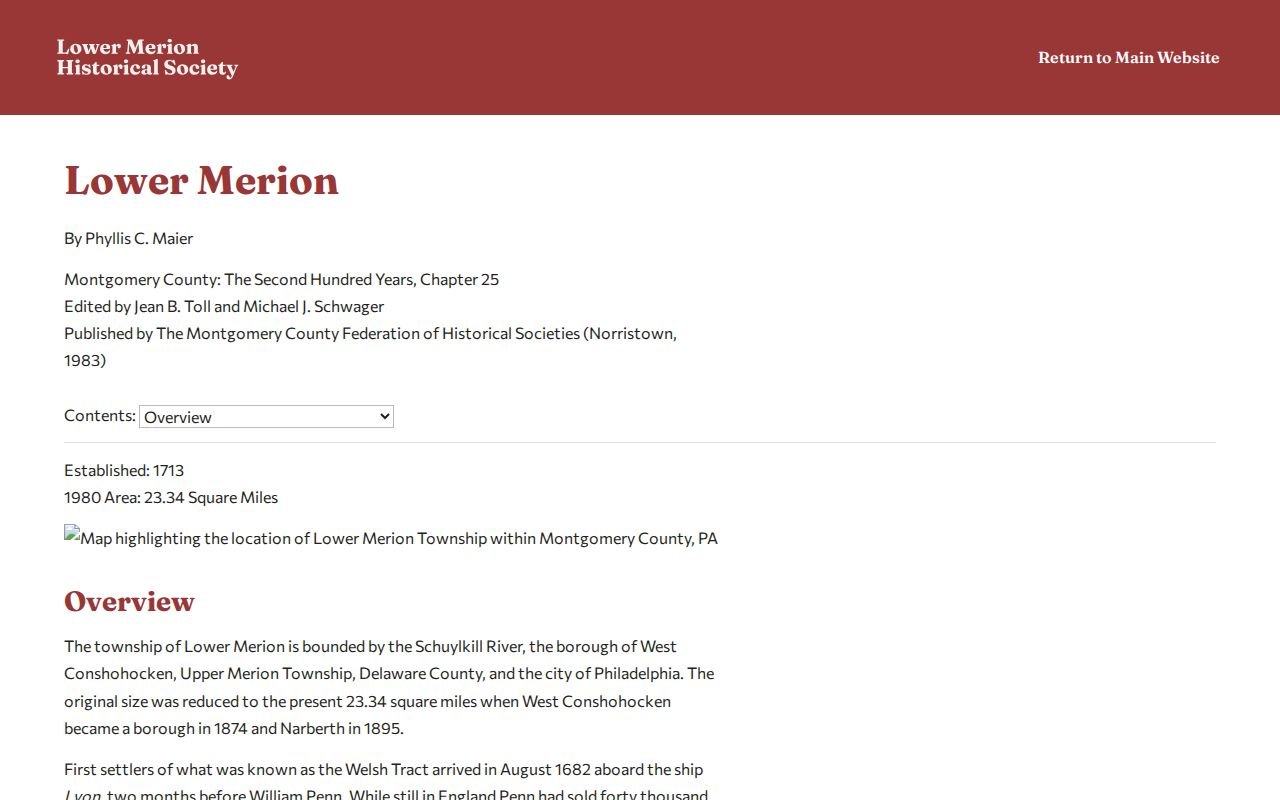
Use the screen as an orientation tool, then cite the actual directory title and page once it has been inspected. That distinction keeps a source trail clear for later family or property research.
Lower Merion City Directory Address Checks
A printed address is most useful when it leads to a modern parcel and then backward through historical evidence. Start with the Montgomery County property record to preserve the parcel identifier, last sale, deed book and page, and legal description. The property record can identify an owner or mailing address, but it does not prove who occupied the property. For an older address, compare the listed street and locality with the Township atlas sequence, which runs from 1871 through 1961, and then work from the later plate to earlier plates.
Where the historic number is absent, use the building footprint, nearby roads, rail line, Mill Creek, lot, or adjacent owner to bridge the address. The official local guide warns that streets changed and many plates omit house numbers. A useful corroboration chain is directory or community publication, then address, parish, or school evidence, then county parcel and deed evidence. For a current street-focused record trail, use the Lower Merion by-street directory.
Trace Households With Lower Merion City Directories
Dates matter more than volume count. These local publications are separated by years and often limited to a community or organization, so use them to make a dated household trail rather than an uninterrupted annual sequence. The closest available federal census can supply a household snapshot. A community directory, club publication, yearbook, map, or burial record can narrow the period between census years. The Pennsylvania historical census material has a major exception: the 1890 schedule was destroyed in the 1921 fire.
- Choose the likely local publication by date and community, then record its full citation before extracting any name or address.
- Copy the exact printed spelling and locality. Search period names such as Athensville, Merionville, or Academyville when the time period supports them.
- Match an address to the closest atlas plate or parcel evidence. Preserve the legal description and deed book and page when available.
- Pair the dated publication with the nearest available census enumeration, treating each source as a time-specific snapshot rather than a continuous roll.
- Test a disappearance or move with yearbooks, LMHS burial records, clipping files, estate material, or an additional address record.
A missing name can reflect a move, a changed spelling, a nonmember, a coverage limit, or a missing volume. It does not establish death or departure on its own. Pair it with vital, burial, deed, probate, or census evidence, and keep the original publication citation attached to every conclusion. That restraint is essential because these are valuable local fragments, not a complete township register.